
Inside a Cyber Attack.
How Hackers Break Networks and How Defenders Stop Them
What actually happens during a cyber attack? How do attackers get in, what do they do once inside a network, and how do defenders detect and stop them? This bootcamp follows a real attack step by step, from the initial breach to data theft and incident response, then puts you on the defending side.
Methodology
- MITRE ATT&CK-aligned
- APT-focused campaign & detection

2
Training days
6
Core modules
100%
Online delivery
1
Live attack simulation
Build your cyber defence
Cyber attacks are no longer rare events affecting only large technology companies. Companies, hospitals, governments and critical infrastructure can all become a target. This is an operational introduction to how those attacks really happen and how organisations respond.
The attack lifecycle
How an attack unfolds from initial access to exfiltration, as one connected chain.
Red, Blue and SOC
Who does what on each side of an incident, and how the teams work together.
Moving inside a network
Reconnaissance, credential reuse, lateral movement and privilege escalation.
Real attack techniques
Phishing, credential theft and data exfiltration shown as live demonstrations.
How defenders detect
How logs, alerts and monitoring reveal suspicious activity in real time.
Threat hunting
Turning logs into detections, hunting an adversary's footprints across a SIEM.
Two days, both sides of the incident
Day one you follow the attacker. Day two you defend against them.
Day 1 · The attacker's side
- Session 1
Red teaming foundations: adversary emulation, the attack lifecycle and MITRE ATT&CK.
- Session 2
Reconnaissance to initial access: from Nmap and OSINT to a web shell and a first C2 callback in Havoc.
- Session 3
Privilege escalation and persistence: becoming SYSTEM and surviving reboots.
- Session 4
Credential theft and impersonation: LSASS dumping, Kerberoasting, Pass-the-Hash and Pass-the-Ticket.
- Session 5
Discovery, lateral movement and domain dominance: BloodHound, PsExec/WinRM and DCSync to own the domain.
Day 2 · The defender's response
- Session 1
Log analysis foundations: log types, endpoint telemetry and how a SIEM ties it together.
- Session 2
Microsoft Sentinel and KQL: querying, filtering and visualising security data.
- Session 3
Hunting the intrusion: detecting recon, web shells and suspicious process activity.
- Session 4
Catching privilege escalation and credential theft: token manipulation and LSASS access.
- Session 5
Tracking the adversary: C2 over web protocols, scheduled-task persistence and Pass-the-Hash.
What you walk away with
- Understand the lifecycle of a cyber attack
- Understand how attackers move inside a network
- Understand how security teams detect attacks
- Understand the role of SOC, Blue Team and Incident Response
- Understand the real impact of cyber attacks on organisations
- Participate in a simulated cyber incident scenario
- Understand career paths in cybersecurity
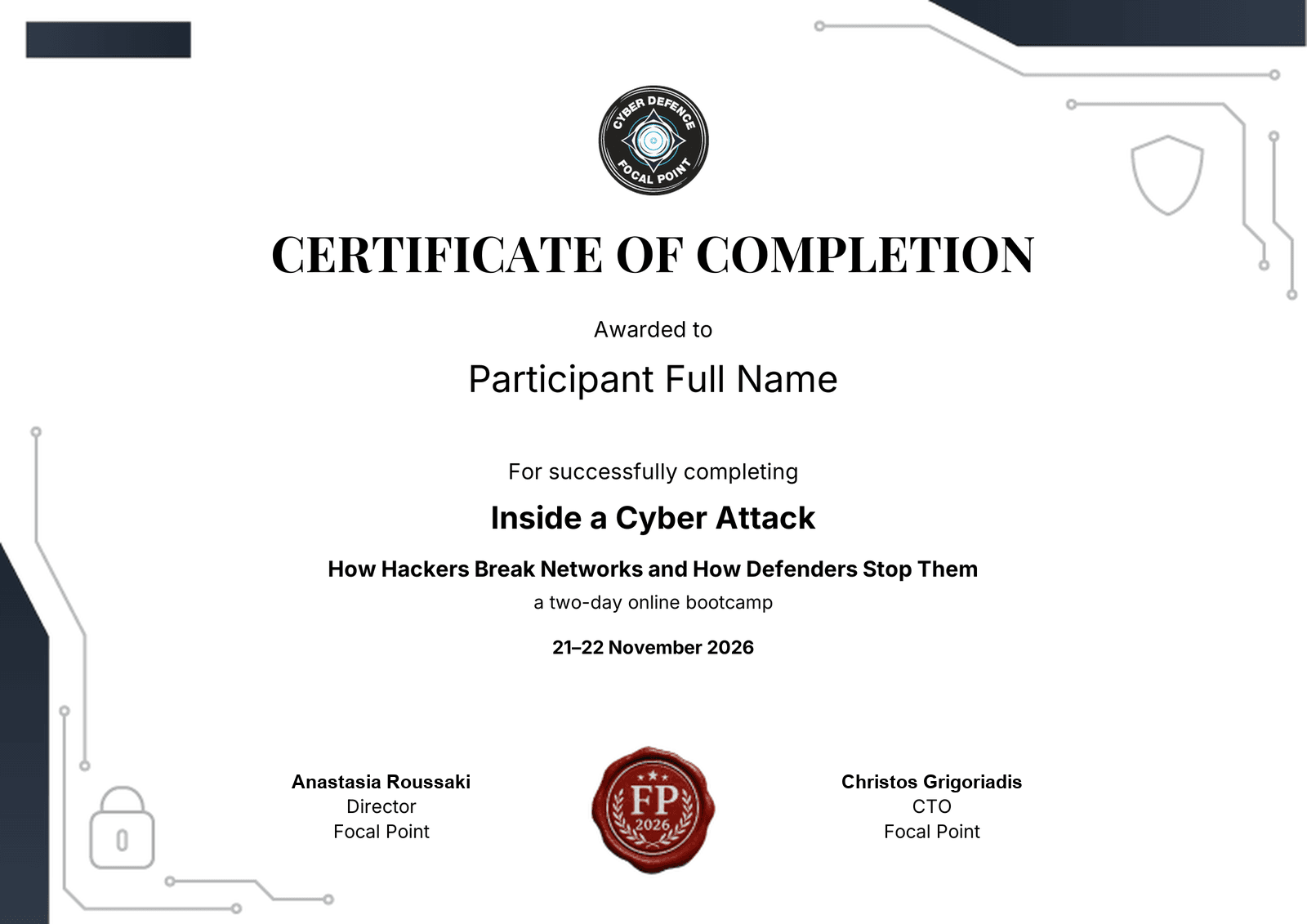
Prerequisites
- No prior hacking or security experience required
- Basic computer literacy is enough to follow along
- A laptop and a stable internet connection
- Curiosity about how attacks and defence actually work
Key details
- Dates
- 21–22 November 2026
- Format
- Online, 2 training days
- Audience
- University students
- Certificate
- Full attendance, both days
Student pricing
Take this bootcamp on its own, or combine it with Cloud Hacking & Cloud Defence for the full four-day picture.
Part of Focal Point Academy. Once registered, you join the Academy community on Discord, where everyone taking the bootcamps comes together.
Follow us on LinkedIn for registration details and announcements.
Registration is subject to our event terms & conditions, including a refund if you cancel at least 30 days before the event.